
The Impact of Bullying on Self-Worth: Understanding the Long-Term Effects

It was something my brother—now in his mid-fifties—once shared with me, framed as a kind of character-building milestone. “It taught me resilience,” he said, with a shrug that seemed to tuck the past neatly out of reach.
He was just eleven when he started boarding school. Far from home, far from anything familiar, and—though it wouldn’t have been described this way back then—far from safety. One morning, he woke to the shock of being pinned down with boiling water being poured over his feet by a group of boys in his dorm who had singled him out as their target.
The physical scars are still there. But to protect his privacy and psychoanalysing him in public too deeply, it’s hard not to recognise that some wounds settle in less visible places, lingering in ways that are far more complex.
People often say it was a different generation. And it was. I understand, the boys responsible faced little more than a token reprimand before being sent back to class. No meaningful consequences. No real acknowledgement of the harm caused. Nothing like the conversations we might expect today. It was simply something to be endured.
There is, thankfully, far more awareness now around the impact of bullying. And yet, it remains deeply prevalent. It still shows up in the stories I hear in my counselling room — from physical abuse to subtle exclusion, undermining comments and the targetted slow erosion of confidence. Alongside this, the rise of cyberbullying means some young people experience relentless, round-the-clock exposure with little sense of escape.
What is clear is that bullying doesn’t simply pass. Many of the adults I work with are not recalling isolated incidents from childhood but living with the emotional imprint of them. The experience of being bullied has become woven into how they see themselves.
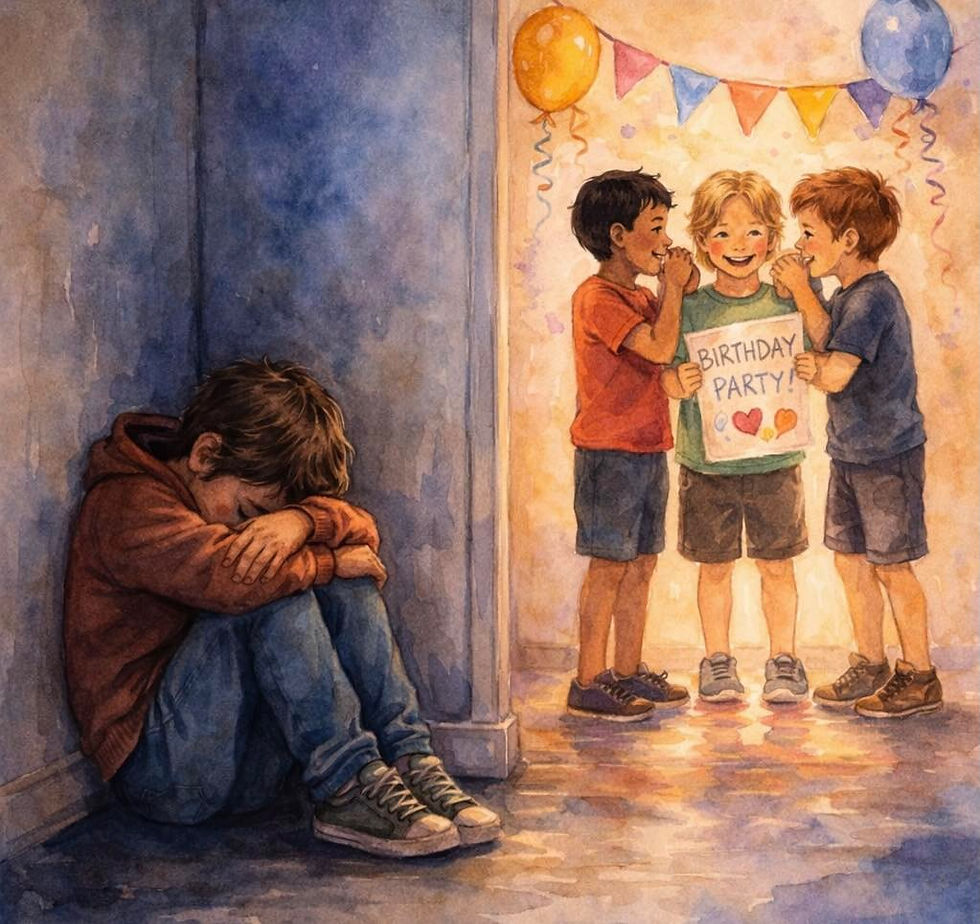
Exploring Bullying from an Attachment Perspective
Bullying can be better understood through the lens of attachment in early relationships. When children grow up with consistent, emotionally available care, they are more likely to develop a stable sense of self-worth. Painful experiences may still hurt, but more often than not a secure attachment means that they are held within a broader sense of being valued and supported, they also have enough trust in adults to relay their experience or ask for help. Where attachment bonds are weaker and a child’s foundation is less secure, the impact of bullying can be more profound. Children may quickly internalise rejection, interpreting it as evidence that something is wrong with them.
Gabor Maté links bullying less to “bad behaviour” and more to shame and unstable self-esteem. In Hold On to Your Kids, he argues that when children lack secure attachment to caring adults, they turn to peer approval for self-worth, which is often conditional and harsh. This fosters shame—a sense of being fundamentally “not okay.” Some children cope by becoming bullies themselves, projecting insecurity outward and trying to feel stronger by targeting others. Others internalise shame, becoming anxious, withdrawn, and more vulnerable to being targeted. In both cases, bullying reflects an unstable sense of self-managed through dominance or submission rather than grounded self-worth.
When Bullying Becomes Internal
Childhood and adolescence are critical stages for developing identity, self-concept, and a sense of belonging. During these years, young people are naturally exploring questions like “Who am I?” and “Where do I fit?”. Feeling accepted by peers plays a powerful role in shaping these answers.
Bullying, often preys upon the very things that make someone who they are—appearance, personality, abilities, or identity. When these aspects are criticised, mocked, or rejected, the impact can run deep. Instead of building confidence, a young person may begin to internalise these negative messages. Rather than seeing bullying as something that is happening to them, they often start to believe it reflects something about them.
Shame, in this sense, thrives in isolation, and because bullying is inherently isolating, it does not simply end but becomes internalised—so that the experience is carried inward and re-enacted through a harsh inner critic, where a person begins to relate to themselves in the way they were once treated.
Over time, these experiences can consolidate into enduring beliefs formed in a time of limited protection and power, rather than conscious choice, culminating in feelings such as :
“I’m not good enough.”
“I don’t belong.”
“Something is wrong with me.”
In therapeutic work, what I have found most striking is not only what happened in the past, but what continues in the present. When adults reflect on their younger selves, I have often found that instead of compassion there is often criticism. The internal voice can echo earlier experiences—harsh, dismissive, unforgiving—carrying the sense that they should have coped better, been stronger, or somehow prevented what happened. The younger self can become something to distance from and vilify rather than care for, with fear, shame, or confusion pushed aside or judged as unacceptable - all of which of course is carried on subconciously into adulthood.
In this way, the impact often shows up not just in memory, but in pattern: avoiding standing out, minimising needs or opinions, holding back self-expression, and beneath it all, a belief that acceptance is conditional. In adulthood, this may continue as difficulty trusting others, people-pleasing, avoiding conflict, over-apologising, or perfectionism driven more by fear than fulfilment. At the core of these patterns is often the assumption that acceptance must be earned, and that being fully seen carries risk. Without awareness, these ways of relating can shape relationships, career choices, and inner dialogue long after the original experiences have ended.
Unlearning to Heal
Many of these responses are often mistaken for fixed aspects of personality. In reality, they are strategies—ways of navigating environments where safety and belonging once felt uncertain.
Therapeutic work involves gently bringing awareness to these patterns, including the inner voice that sustains them. That voice, however familiar, can begin to be recognised as something learned rather than something true.
Self-compassion plays an important role in this process. Self compassion to the child that was bullied and to the adult that has carried the burdens. As described by Kristin Neff, it involves self-kindness, recognising our shared humanity, and meeting experience with presence rather than judgment. In practice, this means responding to the past with understanding rather than criticism.
Not: “What was wrong with me?”
But: “What was I carrying at the time?”
This shift is rarely immediate. The critical voice may even become louder at first and there may be feelings of overwhelm, feelings that have been buried deep finally coming back to the surface. . But over time, with patience and curiosity, the internal landscape begins to soften. What was once a source of shame can gradually become something held with understanding rather than judgement.
Healing is not about erasing what happened. It is about no longer confusing those experiences with who you are and who you now want to be without the burdens carried from the bullying.
And slowly, perhaps for the first time, allowing a different understanding to take root:
You were never the problem.
Comments